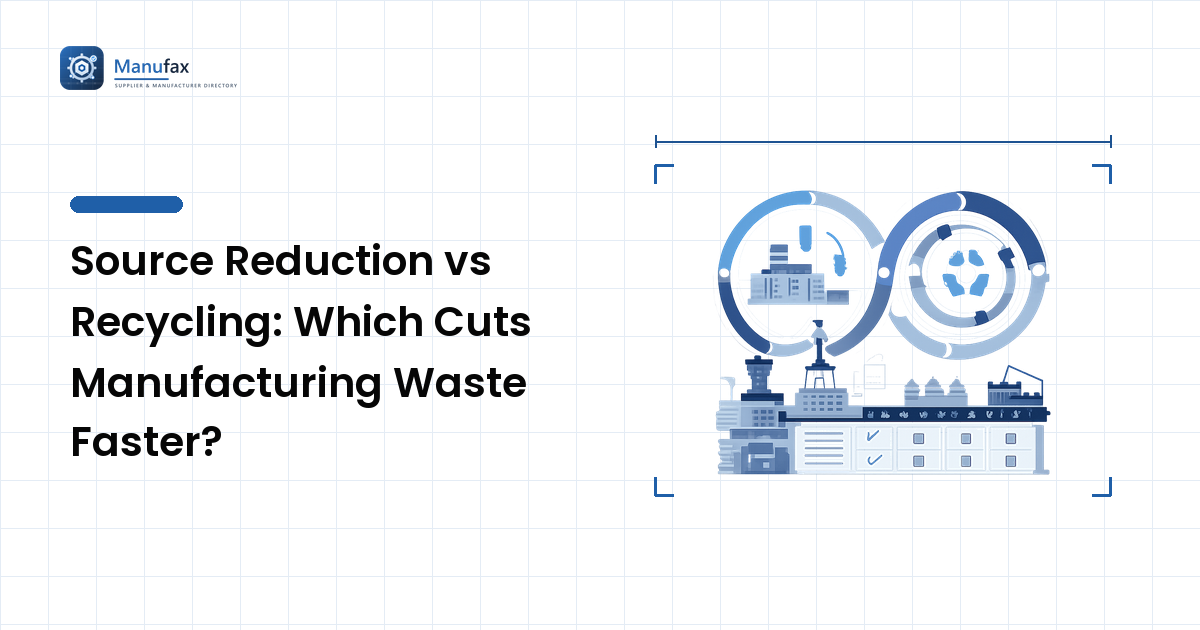
Source reduction cuts manufacturing waste faster and cheaper than recycling because it removes the cost of the material, the machine time, and the labor already spent on it. Recycling only recovers a fraction of the material value after you have paid for all three. Recycle what you cannot prevent — but prevent first.
That order is not a slogan. It falls out of arithmetic on the shop floor, and it is why the standard waste hierarchy puts prevention at the top and disposal at the bottom. This comparison covers the four practical options a plant has, what each costs, and when the lower-priority ones are still the right call.
What are the four ways a plant can handle material waste?
Almost every waste decision on a shop floor is one of these four moves.
Source reduction (prevention). Change the process, tooling, nesting layout, or spec so the waste is never created. Tighter nesting on sheet stock, a fixture that stops first-article scrap, a purge routine that wastes less resin, a packaging change that eliminates a stream of film. Nothing to sort, nothing to haul.
In-process reuse and reclaim. Feed the offcut, trim, or regrind straight back into the same process at the same value — returning runners to the hopper, re-melting drops, filtering and reusing a cleaning solvent. The material never leaves the cell.
Closed-loop recycling (internal). Reprocess scrap on site into usable input, usually at some quality cost — regrinding at a blend ratio, briquetting swarf to recover coolant, reclaiming solvent through a still.
External recycling. Segregate, store, and sell or ship the waste to a recycler. You recover market value on clean, well-separated streams, but you pay for handling, storage, and freight first.
Disposal sits below all four, and is what happens by default when none of the above are set up.
How do the options compare on cost, speed, and effort?
The honest comparison is not "which is more sustainable" — all four beat landfill — but which changes your unit cost, and how much work that takes.
| Approach | What it changes | Capital / effort | Time to visible result | Effect on unit cost | Best when |
|---|---|---|---|---|---|
| Source reduction | Waste is never created | Usually low capital, high engineering attention | Weeks — as soon as the process change holds | Direct: removes material, machine time, and labor | Scrap is process-driven, repeatable, and traceable to a root cause |
| In-process reuse | Material returns to the same process at full value | Low to moderate (granulator, filter, handling) | Days to weeks once handling is set up | Strong: recovers near-full material value | Offcut is clean, uncontaminated, and identical to virgin input |
| Closed-loop recycling | Scrap reprocessed on site at reduced value | Moderate equipment plus qualification work | Months, including quality validation | Moderate: recovers material minus reprocessing and yield loss | Volume is steady and the quality effect can be proven, not assumed |
| External recycling | Waste diverted and partially monetized | Low capital, ongoing sorting and logistics labor | Immediate once bins and a hauler are in place | Small: offsets disposal cost, rarely more | Waste is unavoidable, or streams are mixed and low-volume |
| Disposal | Nothing | None | n/a | Pure cost | Only where regulation or contamination forbids the alternatives |
The pattern is consistent: value recovery drops at every step down the list while handling labor goes up. External recycling is the easiest to start and the weakest lever on cost. Source reduction is the hardest to start and the strongest.
Why does source reduction win on the economics?
Because scrap is never just material. A part rejected at final inspection has absorbed raw stock, several machine cycles, operator time, tooling wear, energy, and floor space — and it will absorb more in sorting and handling. Selling that part back as clean scrap recovers the commodity value of the metal or resin. It recovers none of the conversion cost.
Lean makes the same argument in different language. Defects and overproduction are two of the eight wastes precisely because they multiply every other cost in the process; our lean manufacturing guide walks through the full DOWNTIME checklist. Recycling is, in lean terms, a well-run disposal process for a problem you did not solve.
There is a measurement side too. Scrap shows up in the quality term of OEE — availability × performance × quality — so cutting defect scrap raises the same number you already track on the line. If you use OEE as your efficiency metric, waste prevention and throughput improvement are the same project, not competing ones.
When is recycling the better call?
Prevention-first does not mean recycling-never. Recycling and reuse are the correct answer in several common situations:
- The waste is inherent to the process. Turning chips off a bar, sprues and runners in injection molding, edge trim in converting — some of it is geometry, not error.
- You have hit the design limit. Once nesting, tooling, and spec are optimized, the remaining offcut is fixed until the part or material changes.
- Volume is too low to justify engineering. A short-run job shop cannot re-engineer every job. Clean segregation and a good scrap buyer are the pragmatic answer.
- The material is valuable and easily separated. Copper, stainless, aluminium, and many polymers hold real market value when kept clean and unmixed. Contamination destroys that value, so segregation discipline at the point of generation matters more than anything downstream.
Reuse also carries a quality obligation. Regrind ratios, reclaimed solvent purity, and re-melted stock all change process inputs, and changed inputs change output variation. Validate reuse as you would any process change — a controlled trial plus the process-control thinking in our quality control guide — rather than assuming it will be fine.
How do you decide for your own plant?
Work the streams, not the opinions.
- Quantify each waste stream separately — weight or volume per week, by material and by originating process. A single "scrap" line on a report hides everything that matters.
- Split each stream into inherent and avoidable. Inherent waste is process geometry. Avoidable waste is setup scrap, first-article rejects, defects, expired material, overproduction, and damage. Only the avoidable share is a candidate for source reduction.
- Trace the biggest avoidable stream to its cause. This is a straightforward application of root-cause analysis — find the process step that produces the scrap, not the department that reports it.
- Attack that one cause, and standardize the fix. Setup scrap in particular often collapses once changeovers are disciplined.
- Then optimize handling for what remains. Segregate at the point of generation, keep streams clean, and negotiate on volume once your streams are consistent.
- Repeat on a cadence. Waste reduction holds when it runs as a repeating loop — the whole point of a continuous improvement rhythm.
A note on rules: waste classification, storage, manifesting, and disposal obligations vary by jurisdiction, and hazardous streams carry specific handling and record-keeping duties. Treat anything solvent-, oil-, or chemical-bearing as regulated until proven otherwise, and confirm requirements with your local environmental regulator or the applicable national standard before changing how a stream is stored or shipped.
The verdict
Source reduction wins where it is available, in-process reuse is the strong second, and external recycling is the floor you should never fall below. The sequence for most small and mid-sized plants: quantify streams, separate inherent from avoidable, eliminate the largest avoidable cause, reuse what is clean, recycle what is left.
The trap is inverted effort — an elaborate sorting and hauling program fed continuously by one unresolved process defect. Sorting waste better is housekeeping. Not producing it is profit.
Frequently asked questions
Is source reduction always cheaper than recycling?
Almost always in unit-cost terms, because it removes conversion cost as well as material cost. The exception is when the engineering effort to prevent the waste exceeds the value at stake — typically on very low-volume or one-off work, where clean segregation and resale is the sensible answer.
Does using regrind or reclaimed material hurt quality?
It can, which is why it must be validated rather than assumed. Reprocessed material may differ in particle size, molecular weight, contamination, or consistency. Set a defined blend ratio, run a controlled trial, and monitor the output with the same process controls you use for virgin input.
Where should a plant with no waste program start?
Weigh each stream separately for two to four weeks. Most plants find one or two streams dominate, and that measurement alone usually points to the first project while giving you the baseline to prove improvement later.
How does waste reduction relate to lean's eight wastes?
Material scrap is the physical expression of the defects and overproduction wastes, but lean's list is broader — it also covers waiting, motion, transport, and inventory, which cost money without producing a bin of scrap.
Do we need certification to run a waste reduction program?
No. Environmental management standards give you a formal framework and are often useful for customer requirements, but nothing stops you from measuring streams, eliminating causes, and segregating properly today.
Cut the waste you create
Every kilogram of scrap you prevent is material, machine time, and labor you keep. Every kilogram you recycle is a partial refund on money already spent. Do both — in that order. For more practical, vendor-neutral operations guidance, visit Manufax.