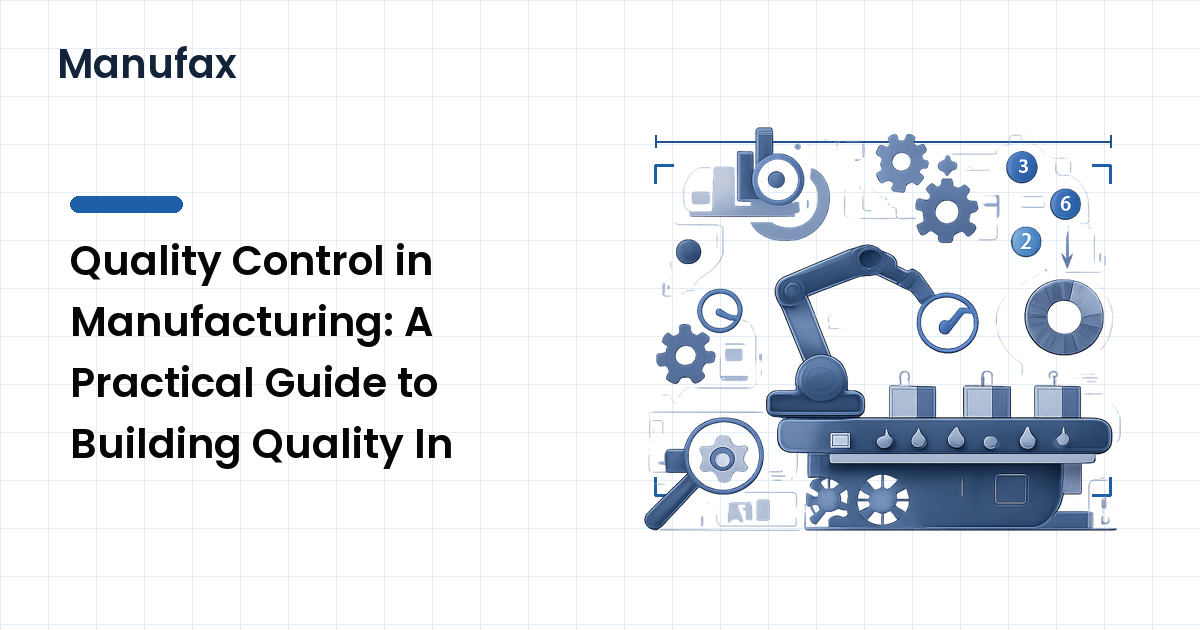
The most expensive defect is the one you find at the end of the line — or worse, the one your customer finds. By then you have already paid for the material, the machine time, and the labor that went into a part you now have to scrap, rework, or replace. Quality control done well moves the catch point upstream, toward the process that makes the defect, and ultimately toward preventing it from happening at all. That shift — from inspecting bad parts out to building good parts in — is the whole point.
The short version: catching defects at final inspection is the costliest, least useful kind of quality control. The goal is to understand where defects come from, measure the process while it runs, and stop the causes before they produce scrap. Inspection still has a place, but it is the safety net, not the strategy.
Quality work pays off most when the process itself is stable and waste is already being squeezed out. If you have not laid that groundwork, the lean manufacturing guide is the right companion to this one — lean and quality reinforce each other on the floor.
Quality control vs quality assurance
These two terms get used interchangeably, but they describe different jobs, and confusing them leads to gaps.
- Quality control (QC) is the reactive side: detecting defects in products through inspection, testing, and measurement. It answers "is this part good?"
- Quality assurance (QA) is the proactive side: designing the processes and standards so defects are unlikely in the first place. It answers "is our process capable of making good parts?"
A plant that leans entirely on QC is constantly catching problems after the cost is already sunk. A plant that invests in QA builds quality into the process so there is less to catch. You need both, but the leverage is in QA — preventing the defect is always cheaper than finding it. Treat inspection as confirmation that a capable process is behaving, not as the thing standing between a bad part and the customer.
Statistical process control: watch the process, not just the part
Statistical process control (SPC) is the core tool for building quality in, because it watches the process while it runs rather than judging parts after the fact. The idea is straightforward: measure a key characteristic over time, plot it on a control chart, and use the pattern to tell normal variation from a real problem.
The distinction SPC makes is the valuable part:
- Common-cause variation is the natural, expected scatter of a stable process. Reacting to it — adjusting the machine every time a reading wobbles — usually makes things worse, not better.
- Special-cause variation is a signal that something changed: a worn tool, a new material lot, a setup error. That is what you investigate and correct.
A control chart turns "the parts seem off lately" into "the process shifted on Tuesday, here is when." That lets operators act on real signals and leave a stable process alone. The discipline that matters is not overreacting to normal variation — chasing every wobble is its own source of defects.
Inspection: necessary, but use it wisely
Inspection still earns its place; the question is where and how much. Checking every single part (100% inspection) is expensive and, for high volumes, often impractical and surprisingly unreliable, because attention fades. Sampling — checking a representative subset using a defined plan — is usually the more sensible approach for established processes, while critical or safety-related features may justify full inspection.
A few principles keep inspection useful rather than wasteful:
- Inspect at the right point — catching a defect right after the step that causes it is far cheaper than catching it at the end.
- Make defects visible early so a problem stops production of more bad parts instead of quietly filling a pallet.
- Use clear standards and gauges so "good" is defined the same way by everyone, not left to judgment.
- Treat inspection data as input, not just a pass/fail gate — the patterns it reveals point to process fixes.
Inspection tells you that you have a problem. It does not fix the problem. That is what root-cause analysis is for.
Root-cause analysis: fix the cause, not the symptom
When a defect appears, the tempting response is to fix the bad part and move on. That treats the symptom and guarantees the defect returns. Root-cause analysis (RCA) digs past the symptom to the underlying cause, so the fix actually holds.
Two simple, proven methods do most of the work on a shop floor:
- The Five Whys — ask "why" repeatedly, each answer feeding the next question, until you reach a cause you can actually act on rather than another symptom. A part failed; why? The tool was worn; why was it not replaced? There was no replacement schedule — and now you have a real fix.
- The fishbone (cause-and-effect) diagram — map possible causes across categories such as method, machine, material, measurement, people, and environment, so the team considers the whole process rather than blaming the obvious.
The test of a good RCA is simple: would the fix prevent the defect from recurring? If you are still adjusting parts after the fact, you have not reached the root cause yet. Fixing causes is what turns quality control from endless firefighting into steady improvement.
Build a quality system that prevents defects
The pieces above work best as a connected system rather than isolated tools. A practical quality system for a small or mid-sized plant comes together in a clear sequence:
- Define quality standards for each product — measurable specifications, not vague expectations, so "good" is unambiguous.
- Identify critical characteristics that most affect fit, function, or safety, and focus measurement there rather than everywhere equally.
- Put SPC on those characteristics so the process is monitored while it runs and shifts are caught early.
- Inspect at the right points with sampling or full checks chosen by risk, as confirmation rather than the main line of defense.
- Run RCA on recurring defects and change the process so the cause is removed, not just the part.
- Track quality metrics — scrap rate, rework, first-pass yield, defects per unit — and review the trend to see whether changes are working.
Built this way, quality stops being a final gate and becomes part of how the process runs. The payoff is less scrap, less rework, fewer customer complaints, and a process you can trust — though the size of that payoff depends on your products and starting point, so measure it rather than assuming a figure.
Frequently asked questions
What is the difference between quality control and quality assurance?
Quality control detects defects in products through inspection and testing — it is reactive. Quality assurance designs processes and standards to prevent defects in the first place — it is proactive. Both matter, but the bigger payoff is in assurance, because preventing a defect is cheaper than catching one.
What is statistical process control used for?
SPC monitors a process while it runs by plotting key measurements on a control chart over time. Its main value is distinguishing normal, expected variation from a real change that needs investigation, so operators act on genuine signals and leave a stable process alone instead of over-adjusting it.
Do I need to inspect 100% of parts?
Usually not. Full inspection is costly, often impractical at volume, and surprisingly unreliable because attention fades. Sampling with a defined plan is generally more sensible for stable processes, while critical or safety-related features may justify full inspection. Match the inspection level to the risk.
What is root-cause analysis and why does it matter?
Root-cause analysis finds the underlying reason a defect occurs rather than just fixing the defective part. Methods like the Five Whys and fishbone diagrams trace symptoms back to a cause you can act on. It matters because fixing the cause prevents recurrence, while fixing only the symptom guarantees the defect returns.
Which quality metrics should a small plant track?
Start with scrap rate, rework, first-pass yield, and defects per unit. These connect directly to cost and tell you whether quality is improving. Track the trend over time rather than a single reading, and use the patterns to point at which processes need root-cause work.
Next step
Pick the defect that costs you most — the one that shows up most often or scraps the most expensive parts — and run a root-cause analysis on it. Trace it back with the Five Whys, change the process step that produces it, and put a simple measurement in place to confirm the fix holds. Do that one defect at a time and you steadily shift quality control from catching bad parts at the end to building good ones from the start, which is where the real savings live.