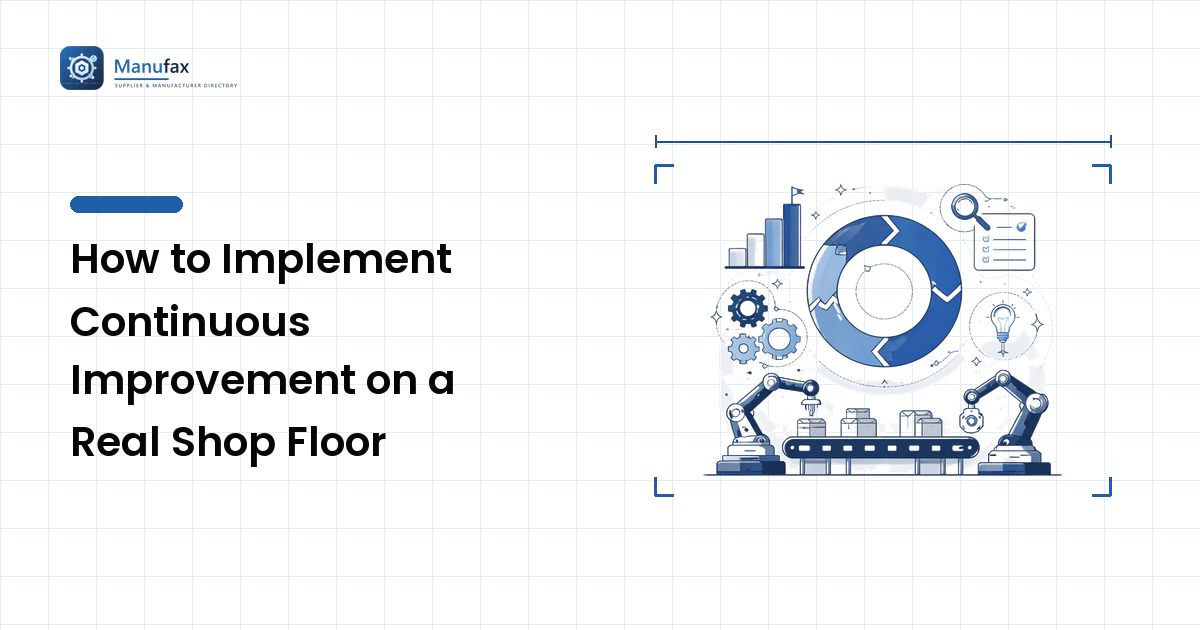
To implement continuous improvement, pick one measurable process, baseline its current performance, and run short PDCA cycles — Plan, Do, Check, Act — with the operators who do the work. Standardize every change that holds, review progress on a fixed cadence, and only then expand to the next process. Small, verified, repeated improvements beat large programs.
That is the whole method. What makes it hard is not the theory but the sequencing: most stalled improvement programs started too wide, measured nothing, and had no owner once the launch enthusiasm faded. This guide walks the rollout in the order that actually survives a busy production quarter.
What is continuous improvement in manufacturing?
Continuous improvement is the ongoing, structured effort to make processes better in small increments — less waste, fewer defects, shorter cycles, safer work — rather than waiting for a capital project to fix things. In Japanese practice it is kaizen, "change for the better," and it is one of the five lean principles covered in our lean manufacturing guide.
Two things distinguish it from ordinary problem-solving. First, it is continuous: improvement is a standing routine, not a response to a crisis. Second, it is distributed: the people running the machines identify and test the changes, because they see the process every shift. A program where all ideas come from the office is not continuous improvement — it is engineering with extra meetings.
How do you start a continuous improvement program?
Start narrow. One line, one cell, or one recurring problem — not the whole plant.
- Pick one process with a visible, agreed problem. Choose something the team already complains about: a changeover that drags, a station that stops the line, a defect that keeps coming back. Enthusiasm is easier to earn on a known pain than on an abstract target.
- Baseline it with real numbers. Measure what the process does today before changing anything — cycle time, scrap rate, downtime minutes, or OEE. Without a baseline you cannot tell improvement from noise. Our OEE guide covers the standard calculation: OEE = availability x performance x quality.
- Name an owner and a cadence. One person is accountable for the improvement, and the team reviews it on a fixed schedule — a short daily huddle at the board, a weekly review of the numbers. Cadence is what keeps the work alive when production gets loud.
- Go see the process. Stand at the station and watch several full cycles. Time it. Note every wait, walk, search, and rework. What people describe in a meeting and what the process actually does are rarely the same.
- Run a short PDCA cycle. Plan the change, do it on a small scale, check the result against the baseline, act — adopt, adjust, or abandon. Keep cycles to days or weeks, not quarters.
- Standardize what works. Write the improved method into the standard work, setup sheet, or control plan. An unstandardized improvement decays as soon as the person who made it takes a day off.
- Make results visible. Post the baseline and the current number where the team can see them. Visibility drives more ideas than any incentive scheme.
- Expand deliberately. Only after the first process holds its gain do you take the method to the next area — with the first team's people helping teach it.
Which continuous improvement method should you use?
Different problems call for different tools. Matching the tool to the situation matters more than mastering all of them.
| Method | Best used when | Typical duration | What it produces |
|---|---|---|---|
| PDCA cycle | Any incremental change you can test small | Days to weeks | A verified change, adopted or rejected |
| Kaizen event | A defined problem needs focused, cross-functional effort | 2–5 days | A rearranged process and new standard work |
| 5S | The workspace itself causes searching, motion, and errors | Weeks, then ongoing | An organized, self-auditing area |
| Value stream mapping | Flow between steps is the problem, not any one step | 1–2 days to map | Current/future state map and an action list |
| Root cause analysis | A specific recurring defect or failure | Hours to days | The process condition that causes the defect |
| Standard work | Results vary depending on who runs the job | Ongoing | A documented, repeatable best method |
Most plants get furthest by pairing a daily PDCA habit with periodic kaizen events for the bigger, cross-functional problems — and reaching for root cause analysis whenever a defect refuses to stay fixed.
How do you measure whether continuous improvement is working?
Track a small number of process metrics tied to the problem you chose, plus one or two program metrics that tell you whether the habit itself is alive.
Process metrics — pick what the improvement is supposed to move:
- Scrap and rework rate at the station
- Unplanned downtime minutes
- Changeover time
- Cycle time against takt time
- OEE for the constraint equipment
- Recordable safety incidents and near-misses
Program metrics — evidence the routine is functioning:
- Improvement ideas submitted and, more importantly, implemented
- Time from idea to decision
- Percentage of improvements standardized into documents
- Percentage of gains still holding at a later audit
The last one is the honest test. A program that generates many changes but cannot show sustained gains is producing activity, not improvement. Resist the temptation to attach a headline savings number to every change; measure the process metric, verify it holds, and let the finance conversation follow the evidence.
Why do continuous improvement programs fail?
The failure patterns are consistent across plants of all sizes.
- Launched too wide. A plant-wide rollout spreads attention thin and produces no clear win to point at. One area, done properly, is more persuasive than ten started.
- No baseline. Without a before number, every result is arguable and every improvement is deniable.
- Ideas without decisions. A suggestion box with no response schedule teaches people their input goes nowhere. Decide quickly, even when the answer is no, and say why.
- No standardization. Gains that never enter the documented method quietly reverse within months.
- Improvement as an extra job. If the routine has no protected time — even 15 minutes at shift start — production always wins the conflict.
- Blame instead of process focus. Problems get hidden the moment reporting one is risky. Keep the discussion on the process condition, not the person.
- Cutting corners on safety. Any change touching guarding, energy isolation, or lockout/tagout goes through your normal safety review and applicable local regulator or standard before it runs. Speed is never a reason to bypass it.
FAQ
How long does it take to see results from continuous improvement?
The first process usually shows a measurable change within weeks, because early PDCA cycles target obvious waste — searching, waiting, unnecessary motion. A cultural shift, where operators raise and test improvements without being asked, takes considerably longer and depends on how consistently management responds to ideas. Judge early progress by whether the cadence is being held, not by the size of the savings.
Do we need certified staff to run continuous improvement?
No. Formal training such as Lean Six Sigma belts helps with statistical problems and gives a shared vocabulary, but PDCA, 5S, and basic kaizen can be taught internally in a day. Start with a small internally trained group, and consider formal certification when your problems genuinely require deeper statistical tools like SPC or designed experiments.
What is the difference between kaizen and a kaizen event?
Kaizen is the ongoing habit of small daily improvements made by the people doing the work. A kaizen event (or blitz) is a scheduled, focused workshop — typically a few days — where a cross-functional team redesigns a specific process end to end. Events create step changes; daily kaizen holds and extends them. Running events without the daily habit tends to leave the gains unsupported.
How do we keep improvement going when production is behind?
Protect a small, fixed routine rather than large blocks of time: a short stand-up at the board, one owned action per week, and a standing review slot. Also target the improvements at the constraint — the step limiting output — so the work reduces the backlog rather than competing with it.
Should improvement ideas come with a cost justification?
Not for small changes. Requiring a business case for every idea kills the volume of low-cost improvements that make the program work. Set a threshold below which a team can simply test a change under PDCA, and reserve formal justification for spending above it.
Next step
Choose one process this week — the changeover everyone dreads, the station that stops the line, the defect that keeps returning. Measure it before you touch it, name an owner, and run one PDCA cycle to completion including standardization and a verification check. That single closed loop, done properly, teaches the method better than any training deck. For more practical, vendor-neutral operations guides, see manufax.net.