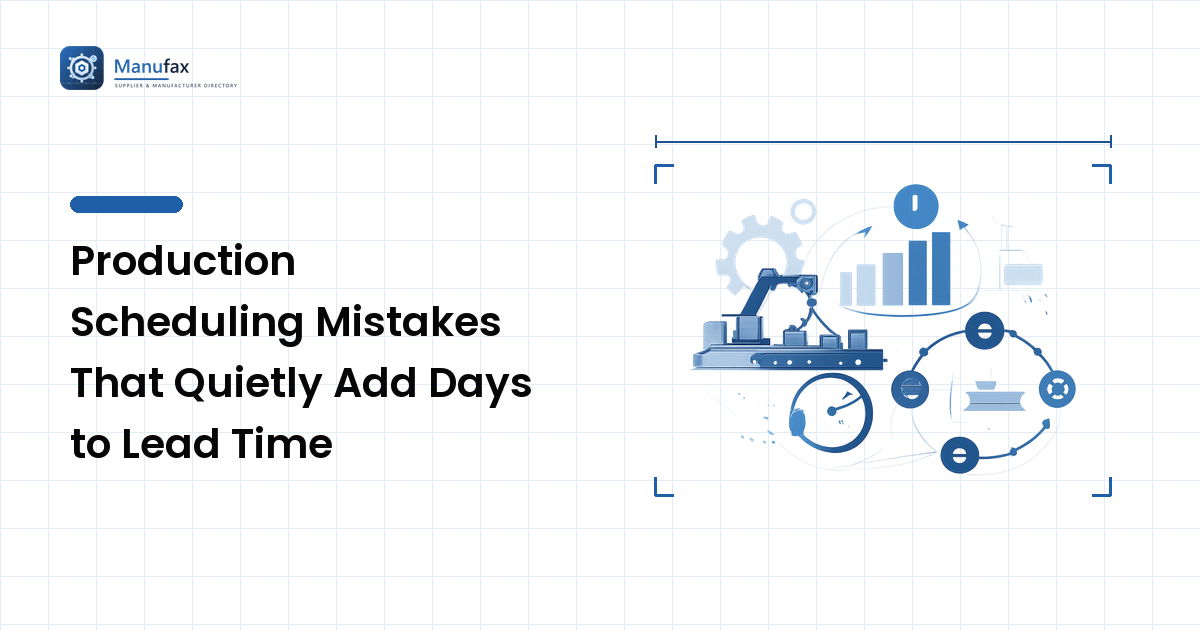
Ask a plant why orders run late and you will usually hear about machines: not enough capacity, not fast enough, too much downtime. Then somebody times a single job from release to shipment and finds it spent a few hours being worked on and several days waiting in front of something. The capacity was there. The schedule buried it.
The short version: in most plants the majority of lead time is queue, not work — and queue is created by scheduling decisions, not by machines. That is good news, because scheduling habits cost nothing to change. The trouble is that every mistake below looks like diligence from the outside, which is exactly why they survive.
Each one comes with the reason it is tempting and a check you can run this week with a clipboard.
1. Releasing work to the floor as soon as it arrives
An order lands, the paperwork prints, material is kitted, and the job goes out. It feels responsive. It is also the most reliable way to make everything late.
Work released faster than the plant can finish it does not get done sooner — it gets done in a longer queue. Every job waiting in front of a machine is also in front of every job behind it, so early release stretches lead time across the whole order book while making no single order finish earlier. It destroys visibility too: when everything is on the floor, nothing is clearly next.
Why it is tempting: a busy-looking floor reads as a productive floor, and a released order feels like progress you can report to a customer. Planners are also protecting themselves against material arriving late.
The cheap check: count the open work orders physically on the floor and divide by the number of jobs you complete in a typical day. That is your work-in-process expressed in days, and it approximates the queue a new job will sit through before anyone touches it. If the number surprises you, release is the problem, not capacity. Hold new releases at the office door, let the floor drain for a few days, and watch on-time delivery before you change anything else.
2. Scheduling to keep every machine busy
The instinct runs deep: idle equipment is wasted money, so the schedule should load every asset. On a line with a constraint, loading the non-constraints simply builds inventory in front of the constraint — and inventory in front of the constraint is lead time in disguise.
A machine that is not the bottleneck should have idle time. That idle time is what lets it catch up when a batch arrives late, and what stops it producing work with nowhere to go.
Why it is tempting: utilisation is easy to measure, easy to report, and looks like efficiency. Nobody has ever had to explain a high utilisation figure to a finance director.
The cheap check: put utilisation next to on-time delivery for the same weeks. If utilisation is high and delivery is not, the plant is efficiently making the wrong things at the wrong time. Then find out which resource actually sets the pace — the methods in how to find the real bottleneck take an afternoon — and schedule that one properly, letting the rest follow it.
3. Planning with standard times nobody has verified
A schedule is only as honest as the run times inside it. Plenty of routings still carry the standard set when the part was launched: before the fixture changed, before the material supplier changed, before the operator found a faster sequence, and usually before anyone added setup, first-off inspection, or the walk to the tool crib.
Optimistic standards do not just make one job late. They make the whole week's plan a fiction, and once a plan is a known fiction, people stop scheduling and start expediting.
Why it is tempting: updating routings is unglamorous and never finished, and a standard that runs a little tight makes the capacity plan look comfortable.
The cheap check: take the last twenty completed jobs on one work centre and compare booked hours with standard hours. You are not looking for precision, you are looking for a consistent direction. If nearly everything runs over, the schedule is not tight, it is wrong — and the gap between planned pace and real pace is exactly what takt time, cycle time, and lead time exist to separate.
4. Sequencing jobs without looking at changeovers
Two jobs that share tooling, a colour, or a material can run back to back on one setup, or be scattered across the week across three. Sequencing by due date alone guarantees the scattered version.
The cost rarely shows up as a late job. It shows up as capacity quietly disappearing into setups, which then justifies overtime or a capital request the plant did not need.
Why it is tempting: due-date order feels fair and defensible, and it is what most planning screens sort by out of the box.
The cheap check: count the setups on your busiest work centre for one week, and time three of them honestly, start to finish, including the paperwork and the hunt for the fixture. Multiply out and compare with a week of available hours on that machine. If the total is uncomfortable, the sequence deserves as much attention as the capacity — and the setups themselves are worth shortening.
5. Letting the hot list replace the schedule
Every plant expedites. The mistake is when expedites stop being exceptions. Once a daily hot list exists, the published schedule becomes advisory and the plant reorganises itself around whoever is loudest. Jobs nobody is shouting about drift, which manufactures tomorrow's emergencies — a loop that feeds itself.
Why it is tempting: expediting works. The expedited order does ship. What stays invisible is the cost paid by everything it displaced, because nobody attributes those delays back to the rescue.
The cheap check: for one week, write down every job that jumped the queue and why. Then check how many were already on that week's schedule. If most were, the schedule was fine and the real problem is that nobody trusts it. If most were not, the problem sits upstream in order promising: the plant is agreeing to dates the schedule was never shown.
6. Padding at every level
A planner adds a day. A supervisor adds a shift of margin. Sales quotes longer to be safe. Each buffer is individually sensible, and together they inflate quoted lead time until the plant is uncompetitive on dates while still finishing jobs late.
Padding also hides variation instead of exposing it. Jobs that finish early sit in a staging area waiting for a date somebody invented, and nobody ever learns what the real process time is.
Why it is tempting: everyone doing it has been burned before, and a personal buffer protects the person who set it even though the plant pays for it collectively.
The cheap check: compare quoted lead time with actual working time on a handful of representative jobs — time on machines plus inspection, not time in the building. The ratio between the two is your queue and padding combined. As a rule of thumb rather than a benchmark: if working time is a small fraction of quoted time, the opportunity is in flow and buffers, not in faster machines.
7. Rescheduling the whole plant every day
A plan regenerated nightly and reshuffled every morning is not a plan. Material gets staged for jobs that then move, setups get broken down before they run, and operators learn to wait for today's version rather than prepare for the week.
The opposite extreme fails too: a schedule frozen for weeks detaches from reality and gets ignored. The workable answer is a short frozen window — long enough that the next few days are genuinely stable and can be prepared for, short enough to absorb real changes behind it.
Why it is tempting: rescheduling feels like responsiveness, and planning tools make regeneration effortless, which removes the friction that used to limit how often anyone did it.
The cheap check: count how many jobs changed position between Monday's sequence and Wednesday's. If the first two days keep moving, nobody can prepare for anything, and the material staging and setup work you are paying for is being wasted before it is used.
The pattern behind all seven
Every mistake here grows from the same instinct: do more, sooner, to be safe. Release earlier to be safe. Keep everything loaded to be safe. Pad to be safe. Reshuffle to stay responsive.
Flow works the other way round. Less work on the floor moves faster than more work on the floor, a plan that holds still can be prepared for, and honest numbers beat comfortable ones. That is the logic of lean manufacturing applied to the planning office rather than the shop floor — and the planning office is usually where the bigger prize sits, because nothing has to be bought.
Pick one mistake, run its check, change the habit, and measure lead time again before moving to the next. Changing all seven at once tells you nothing about which one mattered.
FAQ
Why is our lead time so long when the machines are not busy? Because lead time is dominated by waiting, not working. If jobs sit in queues between operations, adding capacity will not help; releasing less work to the floor will.
Should we schedule every work centre or just the constraint? Schedule the constraint carefully and let the rest follow it. Detailed schedules for non-constraint resources create false precision and encourage overproduction upstream.
How much work in process is the right amount? Enough that the constraint never starves and no more. There is no universal number — it depends on your process variation and changeover times — but if you cannot see the floor, you have too much.
Is expediting always bad? No. A genuine emergency deserves an expedite. The warning sign is a standing daily hot list, which means the schedule is no longer what decides sequence.
Do we need scheduling software to fix this? Not to start. Every check above runs on a clipboard, and most of the gain comes from releasing less work and sequencing setups better. Software makes a good process faster; it will happily make a bad one faster too.
Scheduling errors are cheap to fix and expensive to keep, because they consume capacity you have already paid for. Start with the release rule, then the sequence, then the buffers. For more practical operations guidance on running a shop floor that flows, visit Manufax.