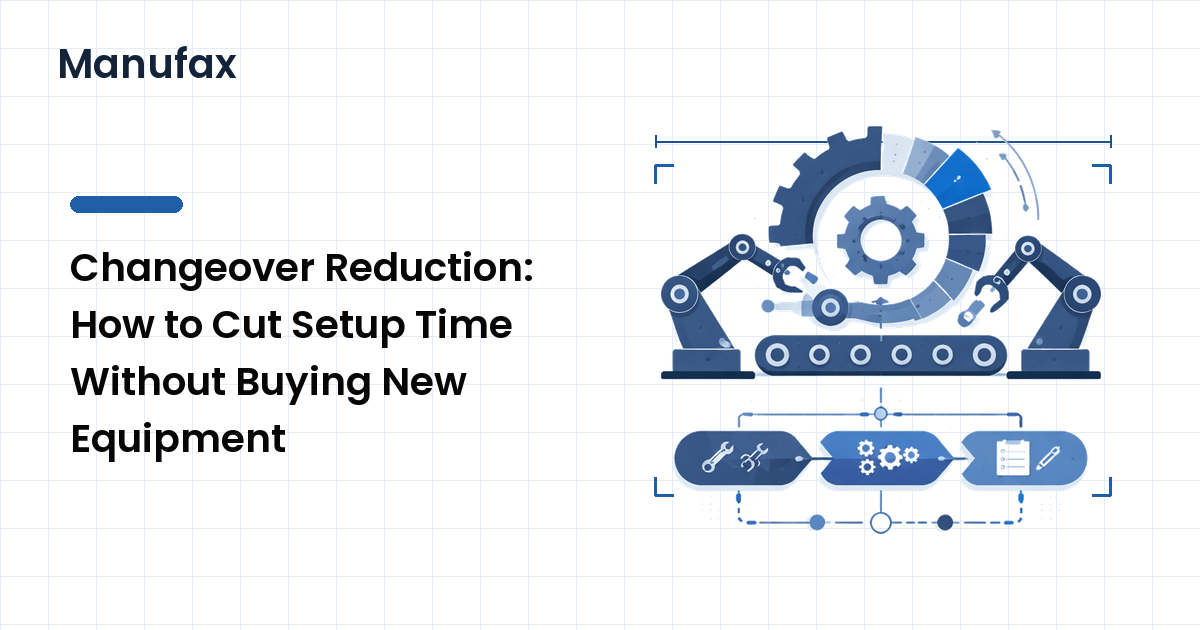
A changeover is dead time. While an operator swaps a die, threads new material, hunts for a wrench, and dials in the first good part, the machine makes nothing you can sell. On a high-mix plant changing over several times a shift, that lost time is often the single biggest reason you can't fit more orders through the same machines.
The takeaway up front: most of your changeover time is waste you can remove with method, not money. The discipline for it is SMED — Single-Minute Exchange of Die — and its central insight is that much of what we call "setup" doesn't require the machine to be stopped at all. Before you quote a new machine to add capacity, look hard at how much capacity your current machines lose to changeovers. It is usually a lot, and most of it is recoverable for the price of attention.
Why changeover time caps your throughput
Every hour a machine spends in changeover is an hour it isn't producing. That makes changeover a pure availability loss — the same bucket downtime falls into when you measure overall equipment effectiveness. But breakdowns feel like emergencies and get attention, while changeovers feel like a normal cost of business, so they get tolerated for years.
The effect compounds with product mix. Long changeovers pressure you to run bigger batches to "earn back" the setup, which inflates inventory, lengthens lead times, and hides quality problems inside large runs. Short changeovers make small batches economical — the foundation of a flexible, make-to-order operation.
A machine that changes over six times a shift at 45 minutes each loses 4.5 hours of production. Halve the changeover and you hand back over two hours of run time a day — capacity you already own and are currently throwing away.
The core SMED insight: internal vs. external setup
The whole method turns on one distinction — every changeover task is either:
- Internal setup — work that can only be done while the machine is stopped: removing the old die, installing the new one, anything that physically requires the equipment idle.
- External setup — work that can be done while the machine is still running the previous job: staging the next die, gathering tools, pre-heating, pre-staging material, and paperwork.
The trap most plants fall into is doing external work as if it were internal — the operator stops the machine, then walks to the crib for tooling, locates the work order, and stages the next material, all of which could have happened while the previous run was still going. Pulling external work out of the stopped window, with no other change, routinely takes a large bite out of changeover time on the first pass — at no cost but organization.
A practical four-step changeover reduction
SMED runs as a sequence. Do it on one machine and one changeover first — your worst or most frequent — before standardizing across the plant.
Step 1 — Record the changeover as it actually happens
Capture how the changeover really goes, not how it's supposed to. Film one full changeover end to end, from last good part of run A to first good part of run B, then list every task in order with its duration. Film it because nobody narrates their own changeover accurately — the walking, searching, and waiting are invisible until you watch them back. That clock is your baseline.
Step 2 — Separate internal from external
Tag each step internal or external. Be strict: the only test is does the machine truly need to be stopped for this? Finding tooling, staging the next die, filling out the run sheet, fetching material — almost always external. Move those tasks into a pre-changeover routine the operator runs before the machine stops. This step alone, done honestly, is where the first big gain comes from — with no equipment changes at all.
Step 3 — Convert internal to external where you can
Now ask which remaining internal tasks can be converted to external with a small change. Common conversions: pre-heat a mold offline so the machine isn't waiting on temperature; assemble a duplicate tool holder while the current job runs; pre-measure material so it's ready at the machine. Each conversion shifts more work out of the dead-time window — and a spare fixture costs far less than a new machine.
Step 4 — Streamline what's left
Whatever stays internal, make it faster and more reliable:
- Kill the search. A shadow board or dedicated changeover cart holding every tool, gauge, and fastener for that job removes the most common waste — walking and hunting.
- Cut adjustment. Replace "feel it out" dial-in with stops, gauge blocks, marked settings, and recorded parameters so the first part is good without trial and error — adjustment and test runs are often the single longest part of a changeover.
- Reduce fastening. Swap threaded bolts for quarter-turn fasteners, clamps, or cam locks where it's safe; a bolt that takes many turns is many turns of dead time. Standardize fastener sizes so one tool fits all.
- Work in parallel. If two people can safely do the changeover, divide independent tasks so they happen at once rather than in sequence.
Lock it in: standardize and sustain
A faster changeover that lives in one veteran's head erodes the week they're on vacation; the gain only sticks when the new method becomes the documented standard.
Write a standard changeover procedure — the ordered task list, the pre-changeover (external) checklist, the tools and settings, and the target time — and make it how everyone does that changeover. Keep timing the actual changeover after each run so a creeping return to old habits shows up in the data, not six months later in your capacity numbers. Then move to the next machine; changeover reduction is never "done," because each pass exposes the next-biggest source of dead time.
One caution: never trade safety for speed. Removing a guard, skipping a lockout step, or improvising a fastener to shave a minute isn't an improvement — it's an incident waiting to happen. Speed comes from removing waste, not from cutting corners.
FAQ
What does SMED stand for, and does it really mean single-digit minutes?
SMED stands for Single-Minute Exchange of Die. The "single minute" is the original goal — getting a changeover under ten minutes — and on many machines that target is reachable. But the number isn't the point. The method earns its keep even if a changeover only drops from 60 minutes to 25, because you've handed real run time back to a machine you already own.
How is changeover reduction different from preventive maintenance?
They target different availability losses. Preventive maintenance reduces unplanned downtime from breakdowns; changeover reduction reduces planned downtime from setups and product switches. Both raise machine availability, but with different methods — and a machine can have excellent uptime and still bleed capacity through slow changeovers.
Do I need to buy quick-change tooling or new equipment to reduce setup time?
No, and that's the main message. The biggest early gains come from separating external work from internal work and organizing tools and parameters — which cost nothing but discipline. Hardware like quarter-turn clamps, spare fixtures, or pre-heat stations helps in later steps, but it's cheap next to a new machine. Start with method; spend only where it clearly removes remaining internal time.
Which machine should I start with?
The one where changeover time hurts most — usually your bottleneck, or the machine that changes over most often. Time lost at a bottleneck is time lost for the whole line, so a reduction there flows straight through to throughput. Prove the method on one changeover, then replicate.
How do I keep a faster changeover from creeping back to the old time?
Standardize it and keep measuring. Write the method down as the standard procedure with a target time, and record the actual changeover on every run. Habits drift; a tracked number makes the drift visible while it's still small, so you can coach it back before it erodes capacity.
Next step
Before you justify new equipment to add capacity, audit the capacity you're already losing to changeovers. Film one changeover on your busiest machine, time it, and split every task into machine must be stopped and could be done while it runs. That single split usually reveals hours of recoverable run time a week — at the cost of organization, not capital. For more practical, vendor-neutral operations guides, see manufax.net.